
April 2026 "The Shared Simulacra of Mathematics and Writing" By Wyatt Tomlinson

Algebra, first developed and written in the 9th century by Muhammed ibn Musa al-Khwarizmi in The Concise Book of Calculation by Restoring and Balancing, is a type of mathematics describing a series of unknown variables, typically “x” and “y,” with “y” being the dependent variable. Along with mathematics, writing goes back to at least the Babylonian Empire and originated with cuneiform. Algebra can represent graphs and, in turn, real-life situations, such as (but certainly not limited to) the motion of an object.
Consider the polynomial and its counterpart:

When graphed, these produce an intersection point. If we take the equation and divide by 3, we get:
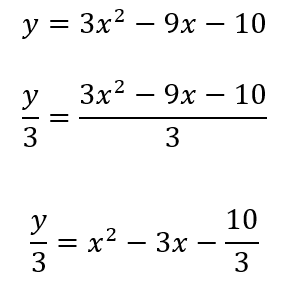
Perhaps surprisingly, this new equation is equivalent to the previous, evident by how its red line covers the previous’ green.

By the same evaluation, the next equations create the same curve, means the rest are also equivalent:

This is further verified by the ratios of “x” and “y”—the curves’ slopes, or, with their slope at every point, their derivatives—remaining consistent between the curves. The equal sign denotes and represents algebraic and geometric equivalence, which are one and the same when translated to a graph, and can model physical situations in real life, such as when the x-axis models time.
Writing describes existence, both in self-evident ways and in the more subtle ways that are worth considering. When someone describes an experience to another person, often times they include a description of what happened, the physical appearance of certain objects, or other characteristics, and the first person describes all of this to the second person using language that is able to “translate” what they saw into a verbal description. Writing codifies this process, preserving these experiences or even thoughts long after either have occurred. The reverse is also true: a description can “map” onto what imagery, physical object, or scene it is aiming to recreate, and thus is a representation of physical reality. This is where imagery comes from, and in turn, fiction, creative nonfiction, and even nonfiction, depending on descriptions and explanations methods. At times we may take this process for granted, but the quality of description—effectively, how well it recreates the scene or wider story it is attempting to—is a key factor in the overall artistic quality in a written piece. In a more granular example, sentences connect to the ideas they are attempting to communicate by either expressing them as intended or not quite causing understanding, and this is where prose and sentence-level writing lives. It too attempts to describe reality, but by expressing thoughts of the author, either intellectually or, returning to the previous examples, in describing scenes. Since words communicate ideas, one word “off” in a sentence can render it less effective or even incomprehensible, and the reverse is true—sometimes, the adjustment of one word is all that is needed.
Over this past school year, I have come to more fully understand what skills writing and the studying of writing in the field of English enable, and how beautiful both are. For my part, I have personal experience with both. If we all know intuitively writing can describe what are essentially aspects of reality, then it would stand to reason that mathematics should be able to do the same. It does, and after all, word problems exist for a reason, as does mathematical modelling. If mathematics was not a language, all of this would be impossible. This holds for statistics as well, as it is a field almost entirely built on representing data with numbers and equations—data itself being a quantified representation of observations about occurrences in real life. Indeed, certain areas of statistics are often written about and even used in writing, all of which often explain a real-world phenomenon. Alongside this, physics describes the inner workings of nature itself. It is only a short extrapolation to extend this to the math behind mathematical modeling and graphs as described in the first section of this essay. Equations and mathematics as a whole are not merely numbers, and neither are sentences merely words. To suggest either would be missing out on appreciation and beauty of various intellectual pursuits. The two might be used for different or perceived to be different aims, but if the criterion for a language is a coherent communication system for describing phenomena, then mathematics falls into that category. At least from a fundamental level, then, mathematics and writing—or the languages used in writing—are not all that different. Many syntheses exist, and they’re there if you know where to look. All this is to say: life is cool.



Comments